

Holistic Voice
The voice knows things the mind hasn't caught up to yet.
Despite the fact that most of us come into the world sounding (crying) and are basically experts at it, most people have a complicated relationship with their own voice. Not the voice as a communication tool…*That* one gets used constantly, often expertly. But the voice as a somatic and expressive instrument: the voice that carries unspoken truth, that trembles at the edge of something real, that has been carefully managed for so long that its owner has forgotten what it sounds like when it isn't performing.
The voice is one of the most direct maps of the interior. It carries what words alone cannot — the history of what has been held, the residue of what was never said, and the raw, unedited signal of authentic presence. I always say that it’s the quickest way to diagnose what is actually happening inside. When someone speaks or “sounds” from a genuinely embodied place, it is immediately recognizable. Not because it is louder or more confident, but because it is real. Something in the listener's body responds before the mind has processed a single word.
Holistic Voice work with the voice as a somatic and expressive instrument — a pathway into the body for connection, expression, and energetic digestion rather than a performance to be evaluated or improved.

The Literal and Metaphorical Voice
Voice work operates on these two registers simultaneously, and they are not as separate as they might appear.
The literal voice — breath, resonance, vibration, the physical act of sounding — is a direct pathway into the nervous system. Humming activates the vagus nerve through vocal cord vibration, shifting the autonomic nervous system toward the ventral vagal state: the neurological condition of safety, connection, and openness that makes genuine integration possible. Sustained toning in specific registers creates somatic vibration that moves through the body's tissues in ways that touch what is held there — tension, unexpressed emotion, thwarted life energy that has been waiting for a safe channel.
The metaphorical voice, or the capacity to speak one's truth, to set a boundary, to say what is actually true rather than what is expected or safe…this lives in the body too. It is not primarily a cognitive skill. It is a somatic one. People who have learned to silence themselves do not think their way into finding their voice again. They feel their way. They breathe their way. They sound their way.
Finding your voice is not a communication skill. It is a somatic one. The expressiveness of the body leads. The words of the mind may follow.
What practitioners of this work observe consistently is that as someone develops a more embodied relationship with their literal voice — with breath, resonance, and the physical experience of sounding — the metaphorical voice tends to follow. The capacity for clarity, for self-expression, for holding ground in a difficult conversation: these become more available not because they were taught, but because the body stopped bracing against them and started regarding the expression of what is really true as familiar territory.
What a session is
Every session begins with a plan, which is then shaped to respond to what is happening in real time. The plan is informed by what you are navigating, what the group is holding, what the moment calls for. What actually unfolds meets what is present in the room: the quality of the breath, the state of the nervous system, what arises when the first sound is made. The work is responsive by nature, and also by design.
Sessions move through breath, resonance, and sound — beginning with what is easiest and safest, building gradually toward what is more exposed. There is no performance expected and no correct way to sound. The only requirement is a willingness to meet what is there — in the body, in the breath, in the voice as it actually is rather than as it is supposed to be.
Other vocal or singing techniques, including polyphonic overtone singing, group vocal improvisation and games, circle-singing, song circles, and other kinds of experiential vocal exploration are available within the work, but they are approached as somatic listening practices rather than skills to be acquired. The question is never 'can you do this?' It is always 'what do you notice or feel when you try?'
No musical experience is required. No “good” voice is required. Only a willingness to listen inward — and to let what is there make a sound.
Sessions are trauma-aware and calibrated to the window of tolerance of each individual or group. The pace is set by what is actually present, not by an agenda. What surfaces is met with curiosity and care rather than judgment or urgency.
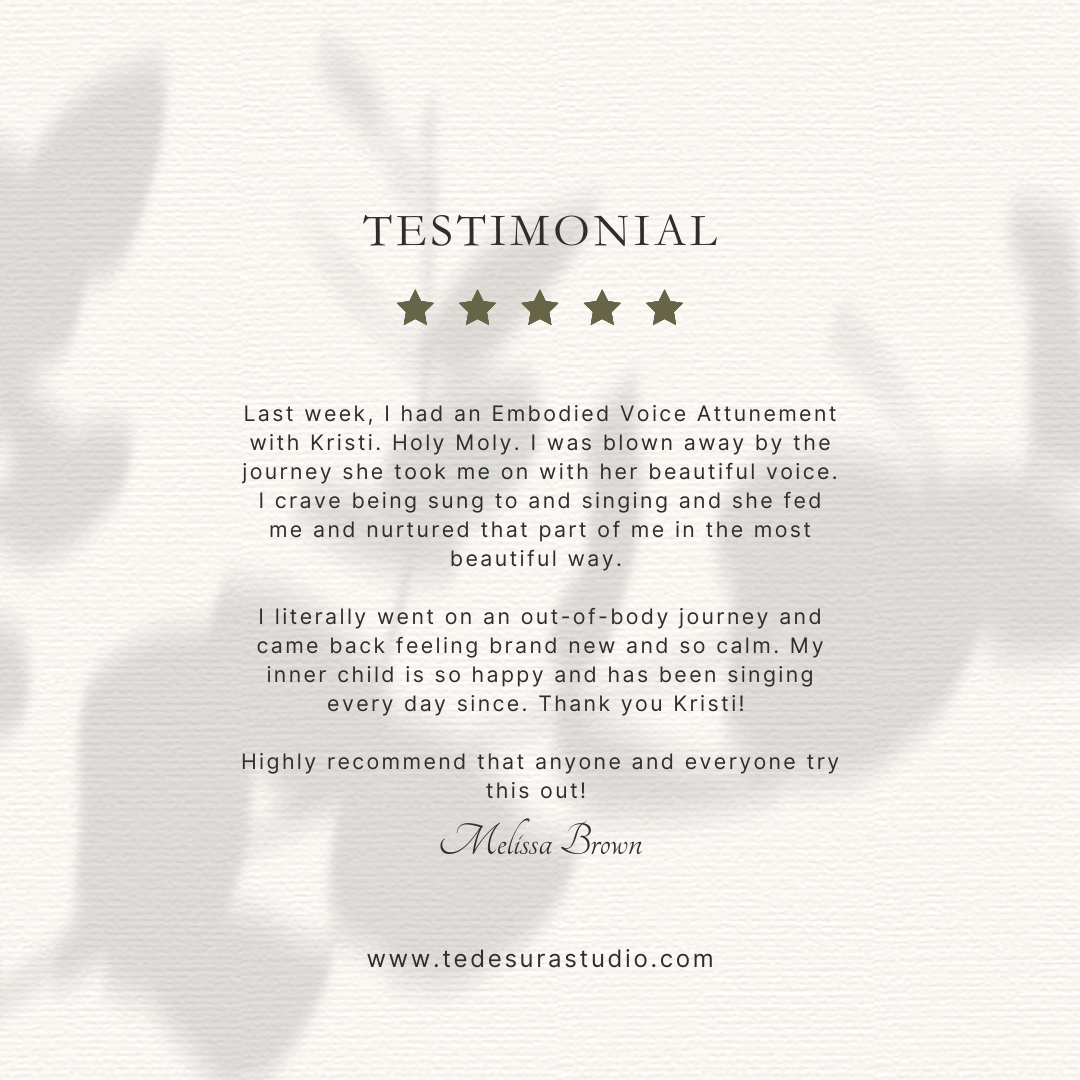
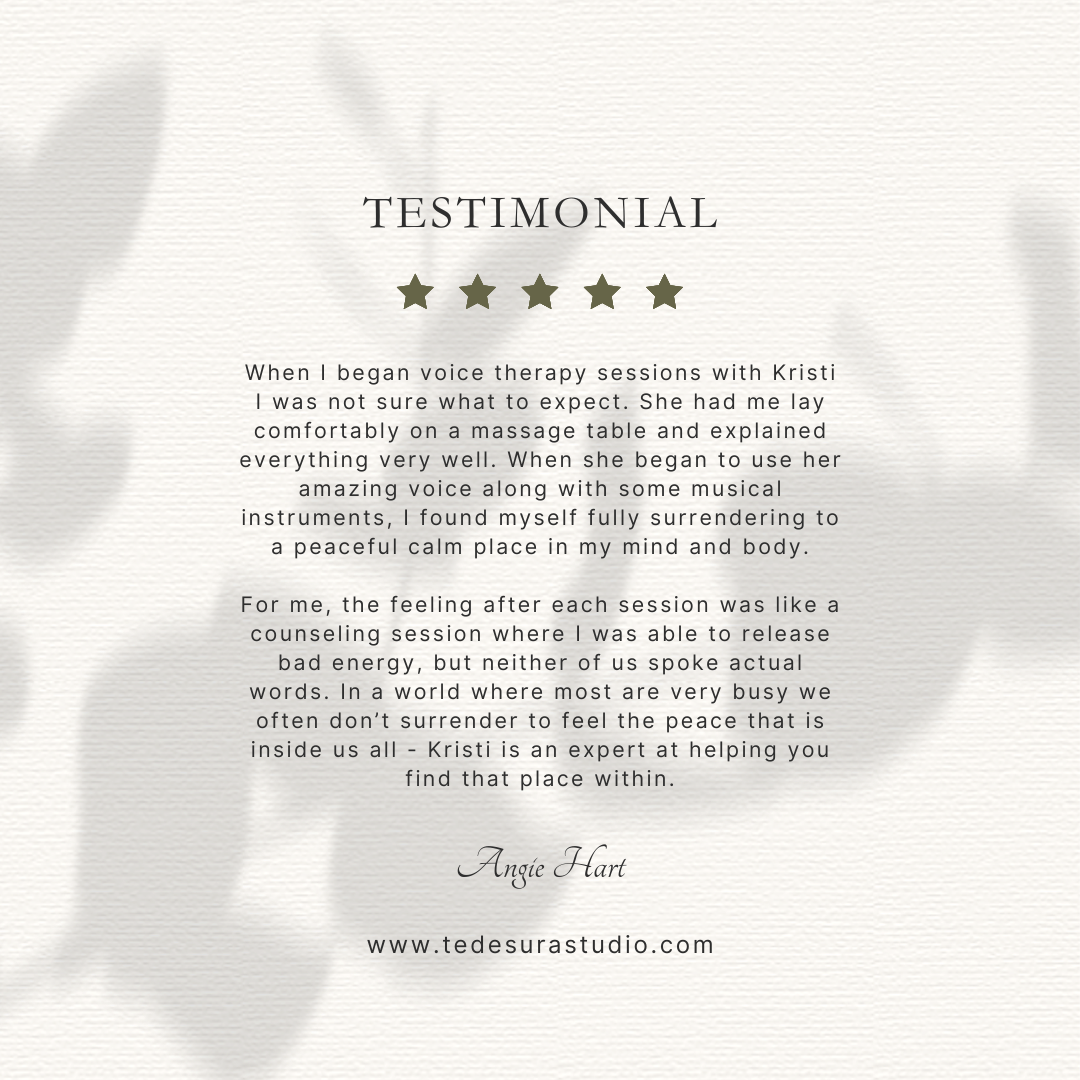
Recent Client Experiences
What This Work is For
People who feel that their voice — literal or metaphorical — has been managed, minimized, or silenced for a long time. People who know they want to sing, or even used to sing but now find that they…can’t. People struggling with what they might call performance anxiety. People who know what they think but struggle to speak it from a place of groundedness rather than anxiety. People navigating leadership, creative expression, or significant life transition. People who have done cognitive work around self-expression and found that something in the body is still holding back.
A particular note for women: the managed, carefully sized feminine voice is not a personal failing. It is a cultural achievement — cultivated over a lifetime in response to very real social forces that shaped what was acceptable, safe, and appropriate to express. The work of finding an embodied voice is therefore not simply expressive or therapeutic. It is a reclamation. The trembling at the edge of genuine expression is not weakness. It is the nervous system registering that something real — and previously unsafe — is about to happen. This work holds that threshold with care, patience, and deep respect for what it has taken to arrive there.
And people who are simply curious — who feel drawn to sound and voice without knowing exactly why, and are willing to trust that pull as information.
No musical background or performance experience is required. This is not voice training in the conventional sense. It is somatic work conducted through the medium of the voice.
The voice is already there. What this work offers is a context in which it can be heard — by you, first.
If you are curious about what embodied voice work might open for you or your group, reach out and let's find out together.