

The Remembered Voice
When was the last time you spoke, sang, or shared a difficult truth freely?
No self-consciousness. Not second-guessing yourself. Not replaying for hours or days afterward how it landed.
If you can't remember a time like that, you're exactly who I made this for.
I spent almost twenty years trapped inside myself, in the exact way I just described. When I finally found my way out, I built Remembered Voice from what I learned in there… my own lived experience woven together with everything my training had taught me about the body, the nervous system, and sound.
This is not about singing. Remembered Voice is the remembrance and reintegration of your true expression, with the voice as the vehicle. What you do with that voice once it's yours again is entirely up to you. Maybe you want to sing. Maybe you want to live more in alignment with what's true for you. Maybe it's finally setting a boundary, or loving yourself enough to take up the space you were meant to occupy.
That's why we don't start with singing. We start with your heart.
Your voice is one of the most direct maps of the interior. When someone speaks, or 'sounds,' from a genuinely embodied place, it's immediately recognizable. Not because it's louder or more confident, but because it's real, and something in the listener's body responds before the mind has processed a single word. That's why we treat the voice not as a performance to be evaluated, but as a pathway into the body, and one of the most reliable signals that buried treasure is nearby.

The Story Behind My Work With The Voice
I used to wear headphones when I sang. Not so I could hear myself. But so I couldn’t.
For a long time, I was caught up in a cycle of expressive silence. I didn’t share my authentic voice in song or writing. If I tried to express my Self, my throat would constrict. I would cough. I would only sing or play the piano when I was wearing headphones. I know what it’s like to hate how my voice sounds in a recording. To avoid phone calls, or hold in a great belly laugh, or hold back with someone I care about — because I’m afraid they won’t like my voice. To have my eyes burn with tears when a teacher publicly shames me for imperfection. To have a panic attack onstage during a solo because I hit one wrong note. To have years of poems, stories, and songs permanently erased by someone who was threatened by the expressive truths of a vibrant inner world that existed beyond their reach. To not express myself musically with my voice or an instrument for nearly twenty years.
And I know what it’s like to overcome all of that.
At a certain point I asked myself one question: am I willing to risk the life I had been living for the one I could live? I said yes. Everything that followed came from that.
I spent years since then doing the opposite — leveraging my training in education, music, somatic movement, meditation, and voice work, to do the slow, unglamorous, deeply worthwhile work of reclaiming the parts of myself that had gone quiet. Then I did what my educator brain couldn’t help but do: I documented it. I mapped the stages, traced the steps, and cross-referenced what I’d lived with existing frameworks until what emerged was something I could actually share forward and make useful for others. Maybe for you.
What I learned that I can’t emphasize enough is this:
When you really commit to working with your voice, it’s not just your voice that is amplified. It’s you. Everything in you that has wanted to be seen and heard. Every part of you that has been waiting patiently or maybe sometimes not so patiently for permission to come through.
This is why I call it Remembered Voice.
Because what we’re remembering isn’t just sound and we’re not using our mind to do it.
We’re working with the body to remember the implicit truth of who you are that you’ve been carrying inside of you…sometimes for decades like me…waiting for the right conditions to be amplified.

The Scientific Basis for “Remembered Voice”
There’s a reason this work is called Remembered Voice, and it’s not poetic license.
You came into the world already sounding. Crying, cooing, expressing, absolutely unedited. Nobody taught you how. It's one of the first things you knew how to do, before language, before self-consciousness, before anyone could tell you your voice was too much or too loud or wrong.
So this work isn't about learning something new. It's about remembering something you knew at the very beginning and then, somewhere along the way, were taught to forget. And the reason I use the term remembering is scientific.
Gabor Maté draws a distinction I come back to constantly. He explains that there is recalled memory, explicit memory, the memory of the mind… the things you can consciously call up and put into words. And then there is remembered memory, implicit memory, the memory of the body… everything the body has kept that the mind never filed away in language. We work with the second kind. The mind is a useful lens and we don't leave it behind, but the things most ready to be seen in you are held in the body. So that's where we go to find them.
Your voice lives in that same territory. Somewhere in the vast archive of the body are the most precious parts of you, the ones that got buried to keep them safe from a world that wasn't ready for them. Remembered Voice is how we go looking. Not to build something new, but to recover what was always yours. Your buried treasure. Your hidden gold.
It's also why I make a distinction between sound and vibration. We use the words interchangeably, but they aren't the same thing. Sound is what the mind makes of vibration once the ear has processed it. Vibration is what the whole body feels, regardless of whether it ever becomes a sound you name. We work with both, but we lean into vibration more than sound, because vibration reaches the body directly, and that’s where the remembering happens.

The Literal and Metaphorical Voice
Remembered Voice work operates on two registers simultaneously, and they are not as separate as they might appear.
The literal voice — breath, resonance, vibration, the physical act of sounding — is a direct pathway into the nervous system. Humming activates the vagus nerve through vocal cord vibration, shifting the autonomic nervous system toward the ventral vagal state: the neurological condition of safety, connection, and openness that makes genuine integration possible. Sustained toning in specific registers creates somatic vibration that moves through the body’s tissues in ways that touch what is held there — tension, unexpressed emotion, thwarted life energy that has been waiting for a safe channel.
The metaphorical voice — the capacity to speak one’s truth, to set a boundary, to say what is actually true rather than what is expected or safe — lives in the body too. It is not primarily a cognitive skill. It is a somatic one. People who have learned to silence themselves do not think their way into finding their voice again. They feel their way. They breathe their way. They sound their way.
Finding your voice is not a communication skill. It is a somatic one. The expressiveness of the body leads. The words of the mind may follow.
What I’ve observed consistently is that as someone develops a more embodied relationship with their literal voice — with breath, resonance, and the physical experience of sounding — the metaphorical voice tends to follow. The capacity for clarity, for self-expression, for holding ground in a difficult conversation: these become more available not because they were taught, but because the body stopped bracing against them and started regarding the expression of what is really true as familiar territory.
What a session is
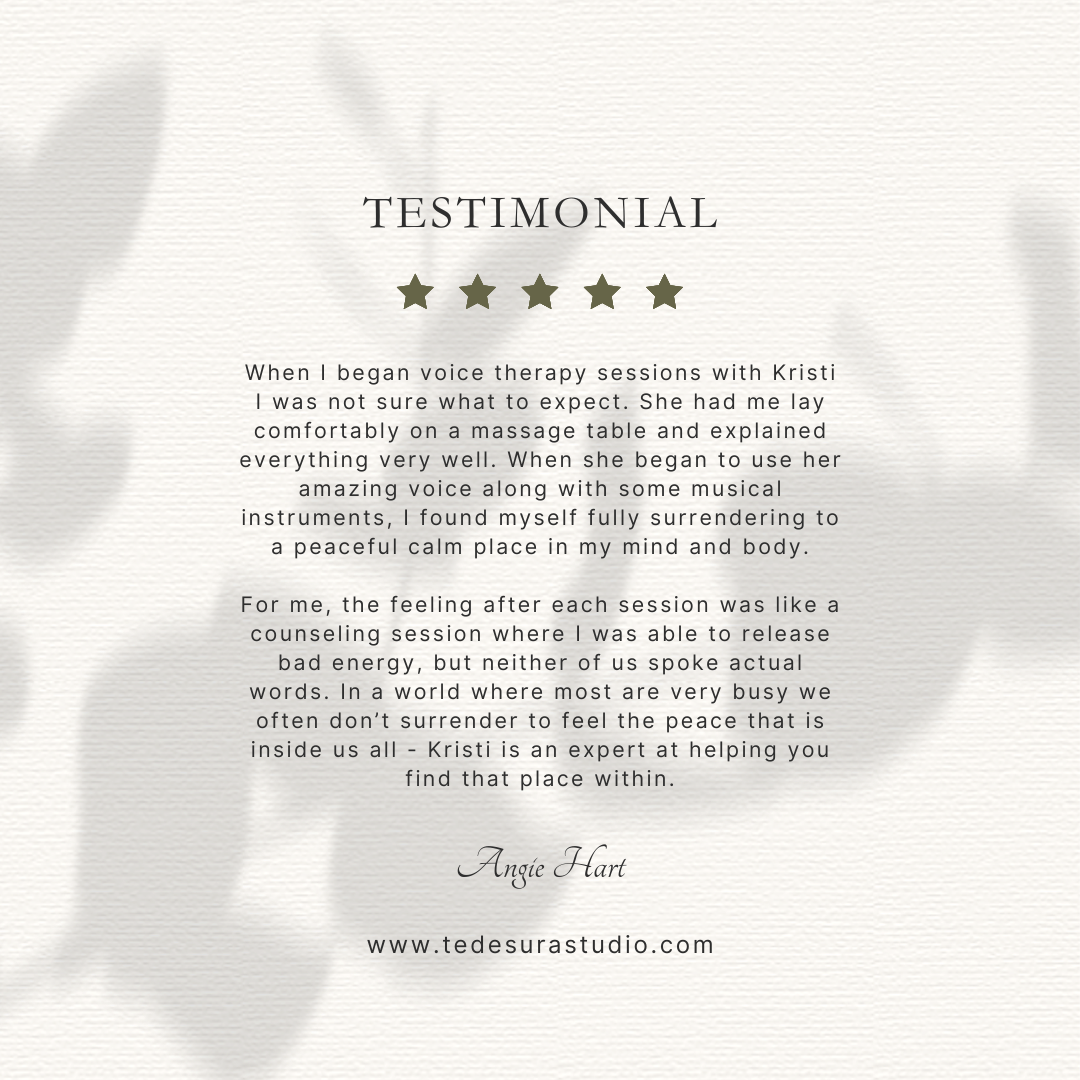
Every session begins with a plan, which is then shaped to respond to what is happening in real time. The plan is informed by what you are navigating, what the group is holding, what the moment calls for. What actually unfolds meets what is present in the room: the quality of the breath, the state of the nervous system, what arises when the first sound is made. The work is responsive by nature, and also by design.
Sessions move through breath, resonance, and sound, beginning with what is easiest and safest, building gradually toward what is more exposed. There is no performance expected and no correct way to sound. The only requirement is a willingness to meet what is there in the body, in the breath, in the voice as it actually is rather than as it is “supposed” to be.
Other vocal or singing techniques, including polyphonic overtone singing, group vocal improvisation and games, circle-singing, song circles, and other kinds of experiential vocal exploration are available within the work, but they are approached as somatic listening practices rather than skills to be acquired. The question is never 'can you do this?' It is always 'what do you notice or feel when you try?'
No musical experience is required. No “good” voice is required. Only a willingness to listen inward — and to let what is there be voiced.
Sessions are trauma-aware and calibrated to the window of tolerance of each individual or group. The pace is set by what is actually present, not by an agenda. What surfaces is met with curiosity and care rather than judgment or urgency.
Lastly, the conditions are something we cocreate. What the voice reveals, what it releases, and where it leads belong entirely to you.
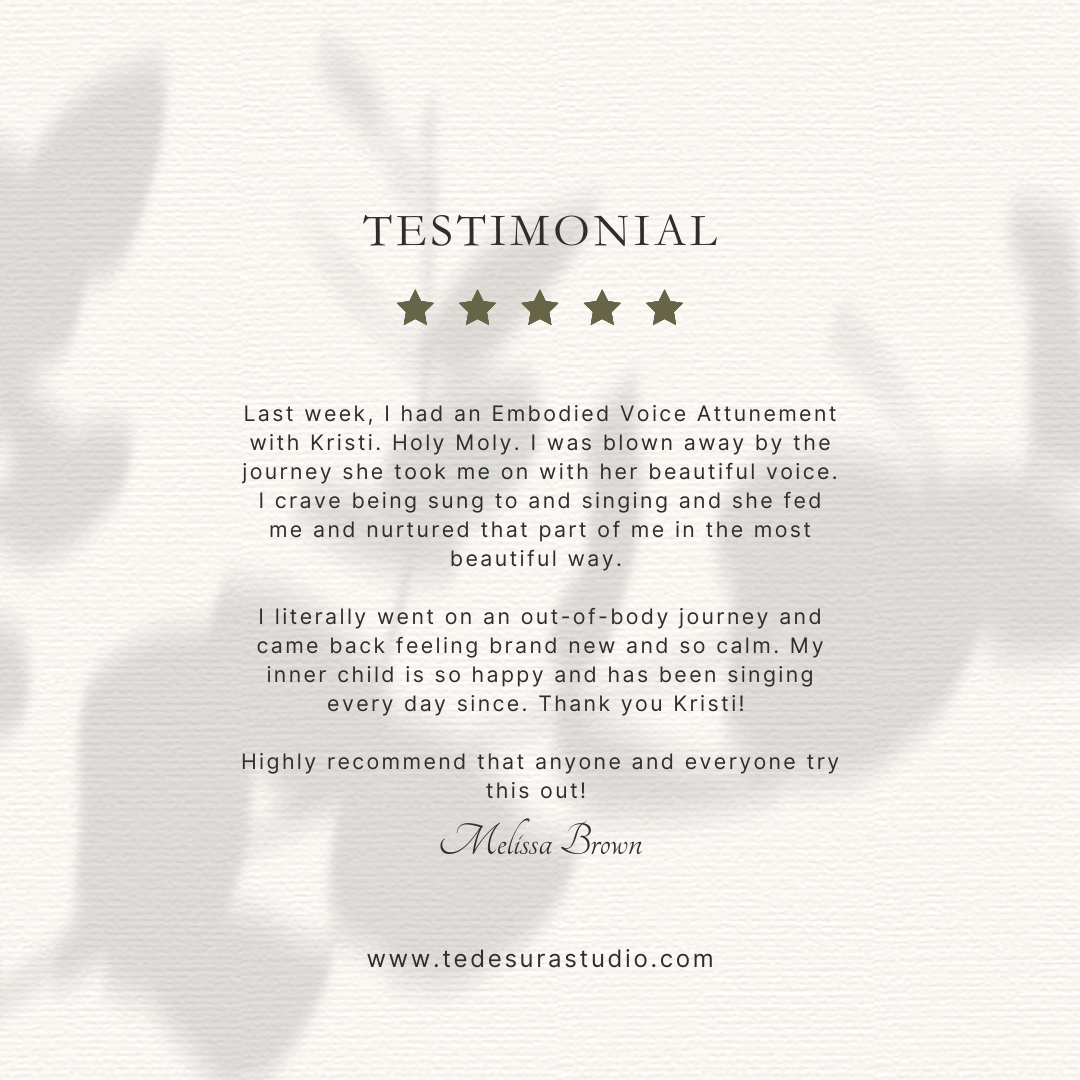
Recent Client Experiences
What is Offered
Individual Remembered Voice Sessions
One-on-one sessions for individuals navigating questions of expression, authenticity, boundaries, or self-knowing and most importantly, who just want to enjoy using their voice more in daily life. You may hear me reference these sessions as “attunements” for that reason. They are wonderful for pulling all parts of you into alignment, and therefore particularly powerful as part of an ongoing integration and transition coaching arc, but also available as a standalone offering for those drawn specifically to the voice work.
Group Remembered Voice Sessions
For retreats, workshops, and gatherings. Group Remembered Voice Sessions create a shared somatic field that individual sessions cannot. When voices join in sound, something becomes available in the collective that is not accessible alone. So, just like individual sessions, I also refer to these as attunements as well. Sessions are designed for the specific context and intentions of each group, with a plan that flexes in real time in response to what is actually needed once we are all together in the room sharing space and our own unique sounds.
Remembered Voice as (Re)Integration
Here is where the two halves of my work meet. Embodied Integration for Daily Life takes a real insight from a threshold moment and integrates it back into how you actually live. Remembered Voice takes your true expression, the part of you that got exiled to survive, and reintegrates it into the self. Same process. Different direction. One moves an insight inward, from a moment of opening back into daily life. The other moves something buried outward, from the dark where it was kept into the light where it can finally be heard.
That’s why, for anyone working within the Journey to Remember, the voice isn’t one tool among many. It’s integration itself, turned toward the voice. It’s woven through every phase, not because it’s a helpful addition, but because the voice is the only instrument you’ll ever have that is literally tuned to you… the one built, from your first breath, to sound what’s true from the inside out.
So when I say the voice is not supplementary to this work, I mean it precisely. It is not support for integration. In its own right, it is integration.
***Sessions are available in person in Portugal and remotely. Remote voice work is more than adequate for individual sessions — the transmission of regulated presence through voice does not require physical proximity.
No musical background or performance experience is required. This is not voice training in the conventional sense. It is somatic work, remembered through the medium of your own voice.
Is This For You?
Start here. When you listen to your own voice, or even just think about it, what comes up?
Sit with that for a second, because your answer is the beginning of the work.
Maybe what comes up is a wall you hit every time you go to speak or sound, and you’ve never known what it was made of. Maybe it’s an old story about your voice, something you were told, or decided, a long time ago, that you’ve carried ever since without checking whether it’s still true. Maybe you know exactly what you think but can’t get it out from a grounded place instead of an anxious one. Maybe you go to set a boundary and feel your voice give out at the precise moment you need it most. Maybe you’ve done all the cognitive work around self-expression already, and found that something in the body is still holding the brake.
Or maybe none of that. Maybe you just feel a pull toward sound and voice and can’t quite say why, and you’re willing to trust that pull as information. That counts too. That’s often exactly where this begins.
And yes, maybe you want to sing, or you used to sing and now somehow you… can’t. You’re welcome here. Singing is just not where we start, and often not the point by the time we arrive.
Notice that none of these is a problem to be fixed. Each one is a door. What you find on the other side of it, and what you decide to do with your voice once it’s yours again, whether that’s to sing, to speak, to set a boundary, to take up the space you were always meant to occupy, or simply to live more in alignment with what’s true, is entirely yours to determine.
If you’re feeling the pull, just start. The rest will follow.
The voice is already there. What this work offers is a context in which it can be heard…first by you and maybe later by others, if you choose.
If you are curious about what Remembered Voice work might open for you or your group, reach out and let’s find out together.