
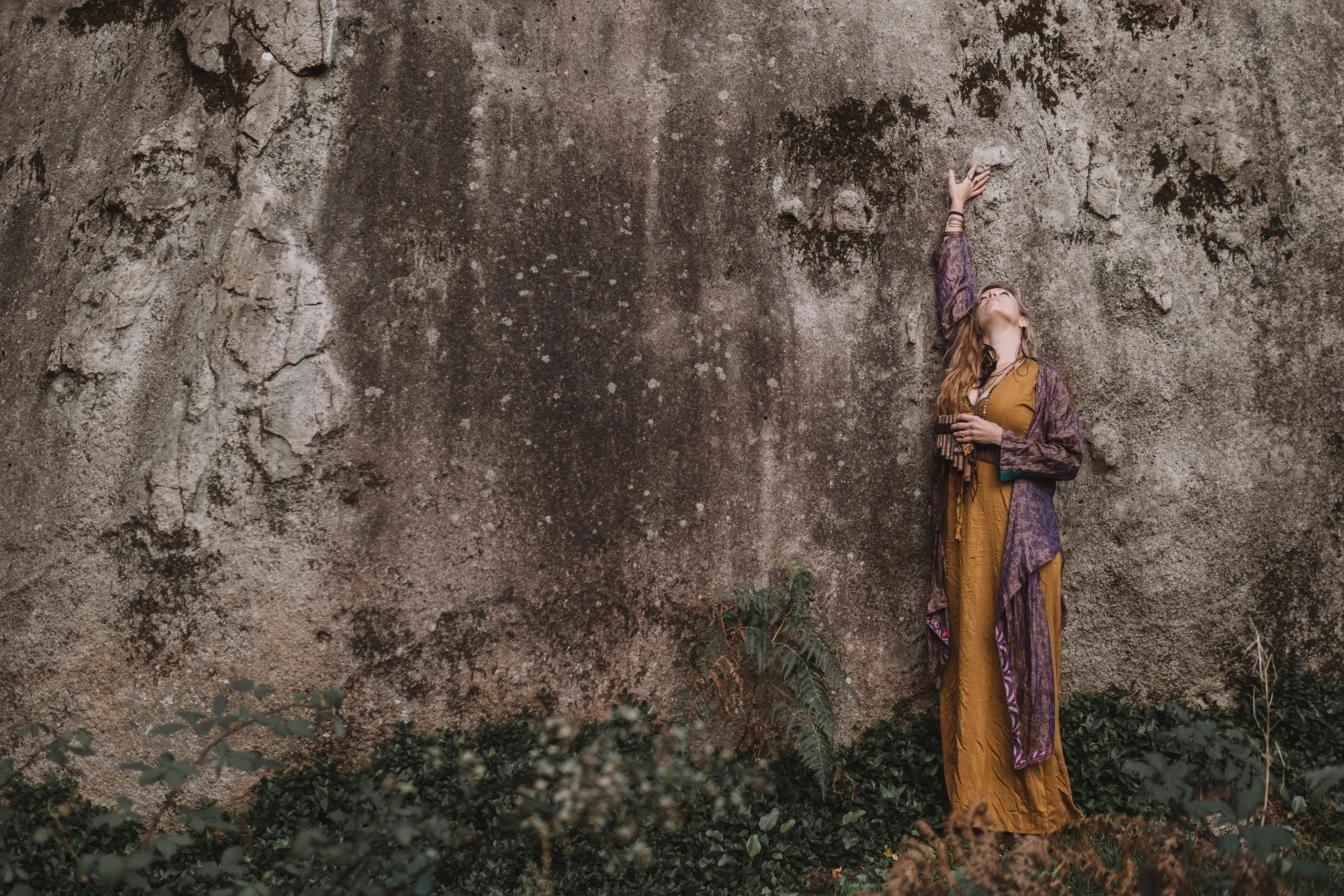
Somatic Education
The body has been trying to complete something. Movement and sensation are how it finally does.
Long before language, the body moved. It moved to discharge what was overwhelming, to celebrate what was alive, to mark the endings and beginnings that words could not hold. Across every human culture without exception, movement has been central to the rituals through which people have navigated transformation — not as exercise, not as performance, but as the body’s native intelligence doing what it was designed to do.
Modern life has largely disconnected us from this capacity. We have learned to manage the body rather than inhabit it — to hold still when something wants to move, to maintain composure when something needs to be discharged, to perform normalcy when the body is carrying far more than normalcy can contain. The result is not stillness. It is contraction. A body that has been holding for a long time.
Somatic education is the invitation to stop holding. To let the body lead, to follow its impulses without performing or correcting them, and to discover what has been waiting to move through.
Somatic education is about learning to read the body’s signals — the most reliable compass we have for navigating the internal landscape and finding the hidden gold buried there.

Movement & Sensation as Integration
In the Journey to Remember framework, movement and sensation are not supplementary to integration — they are among its primary vehicles. The body stores what the mind cannot yet metabolize. It holds the residue of activations not yet fully processed, the tension of transitions not yet complete, the aliveness of possibilities not yet embodied. Talk and reflection can name these things. Movement and sensation are often what moves them — discharging what has been held in the tissues, regulating the nervous system through the body’s own rhythm and momentum, and creating the somatic conditions within which genuine integration becomes possible.
This is not a metaphor. The nervous system encodes activation somatically — in the tissues, the musculature, the breath patterns, the habitual ways of holding and organizing the body. Insight that arrives through movement and sensation arrives at a different depth than insight that arrives through the mind. It bypasses the editorial voice. It lands in the body before the mind has a chance to argue with it.
The body doesn’t often lie, and it never performs — when given the safety to move freely, it goes directly to what is true.
Somatic education at Te de Sura Studio draws on conscious movement, ecstatic dance, and body-led somatic exploration — not as separate techniques but as a unified invitation to the body to do what it already knows how to do. The specific form matters less than the quality of presence and permission that holds it. What matters is that the body is given full agency, that nothing is choreographed or evaluated, and that what emerges is met with curiosity rather than correction.
What a Session Looks Like
Every session begins with a plan and arrives in response to what is present in the room. The facilitator tracks the energy of the individual or group — the nervous system state, the quality of breath, what the bodies in the room are communicating — and shapes the session accordingly. There is always an arc: a way in, a deepening, a way back. But the arc is responsive, not fixed.
Sessions typically move through three qualities of movement and sensation:
Arrival and settling — where the body is invited to make contact with itself and the present moment, regulating the nervous system before any active exploration begins.
Exploration and expression — where movement is invited to follow impulse rather than intention.
Integration and return — where the body is given time to register what has moved through it before re-engaging with ordinary life.
Sound is an integral part of the work, and is used intentionally to support nervous system states, open emotional terrain, and create the conditions within which the body can move freely. The facilitator is not a choreographer or instructor. The role is to hold the field, attune to what is present, and create the conditions within which each body’s own intelligence can take the lead.
What I bring to the room arrives through me, not from me — and the room itself, what you and your body bring to it, shapes everything that follows.
The conditions are something we cocreate. What moves through the body and what shifts belongs entirely to you.
There is no right way to move here. There is only what is honest. And what is honest is always enough.
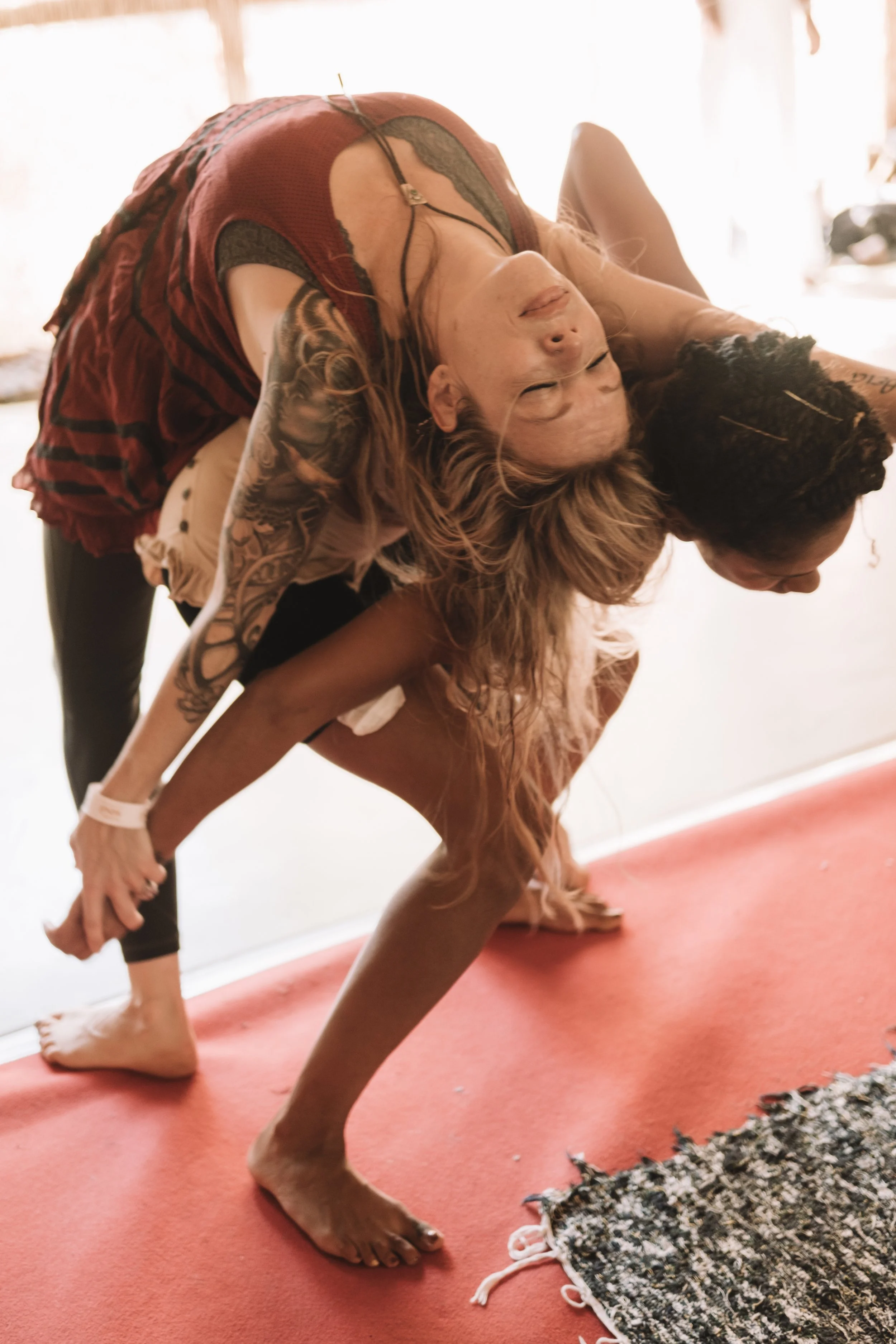
Who This Work is For
People who feel the pull toward movement but have been stopped by the fear of doing it wrong, looking foolish, or not being a dancer. People whose bodies are carrying more than words can currently hold. People who have had powerful activations — retreats, ceremonies, thresholds — and feel the integration living somewhere in the body rather than the mind.
People who have done a lot of cognitive and verbal processing and sense that something still needs to move.
People who are drawn to the idea of letting the body lead, even if — especially if — they don’t yet know what that means for them.
People who simply love to move — who know, in their bodies, that this is one of the ways they come home to themselves.
And last but definitely not least, this work is also for people who don’t necessarily like to move…who feel some resistance to it, not because of active trauma, but simply because they feel some awkwardness or unfamiliarity when connecting with the body through movement or sensation, or for other reasons unknown.
In short, come exactly as you are.
An important note on scope:
This framework is not designed for active or unresolved trauma. That is a precise and intentional boundary — not a limitation, but a commitment to working only in the territory this methodology is genuinely equipped to hold. If that is where you are, the right next step is a practitioner trained specifically for that work. If you are unsure, reaching out for a conversation is always welcome.
What is Offered
Individual somatic education sessions
One-on-one embodied movement and sensation practice — particularly powerful for individuals navigating significant transitions or processing the residue of a powerful activation. Woven into ongoing embodied integration and transition work, or available as a standalone offering.
Group somatic education
For retreats, events, and gatherings of any size. Conscious movement and ecstatic dance sessions designed for the specific intentions of your group — available as a standalone offering or integrated into a broader programming arc. Sessions are shaped in response to the group’s energy and needs in the room, not delivered from a predetermined script.
Movement and sensation as integration support
For individuals working within the Journey to Remember framework, somatic education is woven throughout each phase of the work. The body’s intelligence is not a supplement to the framework. It is one of its primary languages.
***Sessions are available in person in Portugal. Group sessions can be facilitated internationally. All sessions are designed for the non-dancer and the seasoned mover equally — the body you have right now is exactly the body that is welcome here.
The body already knows what it needs.
This work simply creates the conditions for it to show you.
If somatic education calls to you, whether for yourself or for your group, reach out and let’s find out what wants to move.
No experience or prior knowledge with somatics needed - I’m here as your guide and fellow traveler on the most important journey (to remember) that you and/or your group will ever take.
Think of this as guided exploration of your internal landscape with someone who knows the terrain and will walk beside you until you can navigate it yourself.